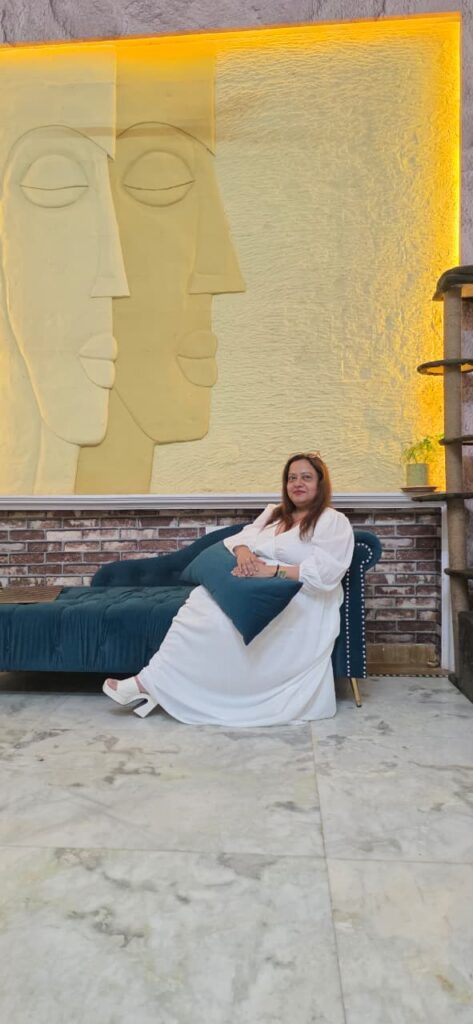

Ar. Smita Das is an architect whose work is deeply rooted in meaning, culture, and human experience. In an industry often driven by uniform designs and rigid constraints, she chose a different path-one that balances tradition with modern needs while keeping people at the heart of every space. Her journey reflects quiet determination, thoughtful creativity, and a belief that architecture should do more than stand tall; it should speak, breathe, and belong.
“Every space carries a story, and my role as an architect is to help that story unfold with honesty, balance, and care.”
Her story began early. At the age of fourteen, while walking through the streets of Berlin, Smita experienced a moment that changed her life. Surrounded by structures that spoke without words, she realized that buildings could tell stories. Every wall, line, and form carried emotion and meaning. That spark stayed with her, even though her family initially hoped she would pursue engineering. Choosing to follow her passion, she enrolled at Sir J.J. School of Architecture in Mumbai, where her sensitivity toward space and human experience began to take shape. Her thesis on the Hoverport Terminal at C.B.D. Belapur was widely appreciated, not just for technical strength but for its strong focus on user experience.
After graduating in 1995, Smita worked with experienced architects, gaining hands-on knowledge that refined her understanding of materials, scale, and design execution. These years built her respect for the craft and strengthened her belief that architecture is as much about listening as it is about creating. In 2016, with years of experience and a clear vision, she founded Speaking Designs in Navi Mumbai. The firm was created to explore architecture that blends high performance with vernacular aesthetics, bringing Indian heritage into contemporary design in an authentic way.
Smita’s architectural philosophy is grounded in what she calls contemporary vernacular-respecting tradition while innovating thoughtfully. Her designs use sustainable materials, passive climate control, and principles rooted in Indian heritage, while still meeting modern expectations. She believes architecture should not dominate its surroundings but grow from them. For her, buildings are not just structures but catalysts for social connection, cultural identity, and collective well-being.
Her journey was not without challenges. Smita chose the slower path of learning and consistency over quick recognition. During the pandemic, when many firms paused work, she transformed her garage into a working studio. That moment became a symbol of her resilience and belief that creativity does not stop when circumstances change-it adapts. What began as a practical solution became a powerful reminder of her commitment to her craft.
Over time, her work expanded from small projects to large institutional landmarks. From designing the Maulana Mazharul Haq Arbi Farsi University, The Patliputra University, The Purnea University in Bihar to creating more than 9,500 customized homes, Smita approached each project with the same care and intent. Residential design holds a special place in her work. She believes homes should make everyday life easier without sacrificing beauty. Every window, corner, and surface is designed to support comfort, warmth, and individuality.

“I believe good design should feel timeless—rooted in culture, guided by nature, and shaped by purpose.”
Her institutional projects are equally thoughtful. Campuses designed by her firm are not just collections of buildings but spaces that encourage interaction, learning, and discovery. Light, ventilation, and openness are used intentionally to create environments that feel alive and welcoming. Her work on the Hoverport Terminal at CBD Belapur is a powerful example of how thoughtful design can combine beauty and practicality, with a clear focus on accessibility and creating spaces that feel connected and grounded.
Smita’s belief in community impact extends beyond her own clients. Through initiatives like her collaboration with UltraTech Cement under the UTEC program, she has worked to make architectural knowledge more accessible. She believes good design should not be a privilege but a shared resource that improves everyday living.
Today, Speaking Designs is supported by a team of over 20 professionals across architecture, interior design, and project management. Under Smita’s leadership, the firm continues to grow while staying true to its values. She also mentors entrepreneurs, especially women, helping them find their footing in the business world.
In 2024, her contributions to architecture and business were recognized by a leading magazine, validating years of quiet, consistent effort. Yet for Smita, recognition is secondary to purpose. Her philosophy of place is simple but profound. Design, for her, is a conversation between people, time, and nature. Guided by Vastu Shastra as a science of balance rather than superstition, she designs spaces that feel harmonious and timeless.
Sustainability has always been central to her work. Long before it became a trend, she focused on passive cooling, daylight optimization, rainwater harvesting, and eco-friendly materials. She believes buildings should respond to seasons, age gracefully, and remain relevant for generations.
Smita Das does not just design buildings-she designs experiences. Her spaces speak in a language of warmth, purpose, and peace. Through patience, principle, and passion, she continues to shape environments that reflect who we are and gently guide us toward who we can become.
“Architecture, for me, is not about buildings alone. It is about creating spaces that listen to people and respond to their lives.”